Best All In One Soundbar Vs Wireless Sub: Real Tradeoffs
By Rafael Ortiz • 25th Sep
Quick verdict
Choose the all-in-one Samsung S60D when compact size and minimal hardware matter most. Choose the Samsung Q800D/KE when you can accommodate its wider bar plus a separate wireless subwoofer and specifically want its documented 5.1.2 layout.
- Choose the S60D if: You need a single, narrower enclosure: the documented regional version is a 5-channel all-in-one bar without an included wireless subwoofer.
- Choose the Q800D/KE if: You have space for its wider bar and separate included wireless subwoofer, and that configuration offers a meaningful benefit for your room and listening priorities.
- Main trade-off: The documented Q800D/KE configuration adds hardware and placement demands; the S60D reduces clutter, while the available evidence does not establish how the two compare in bass performance.
Important: The documented specifications apply to particular regional versions, so verify the exact model and retail package before buying.
The best all in one soundbar is not automatically the smallest bar or the one with the longest feature list. It is the system that fits your room, your furniture, and your tolerance for extra hardware without creating a worse everyday experience. In this all-in-one-versus-wireless-subwoofer comparison, the meaningful divide is straightforward: one compact bar keeps everything in a single enclosure; the other adds a separate bass unit and, in this case, more listed channels. That changes the physical footprint, not just the spec sheet.
I prioritize the path you will actually use. A clean, dependable setup with clear dialogue and a latency budget under 50 ms is more valuable than surround labels you cannot accommodate or features that complicate the HDMI chain. Protect the latency budget; then layer Atmos and extras.
1. Start with the real choice: one object or two
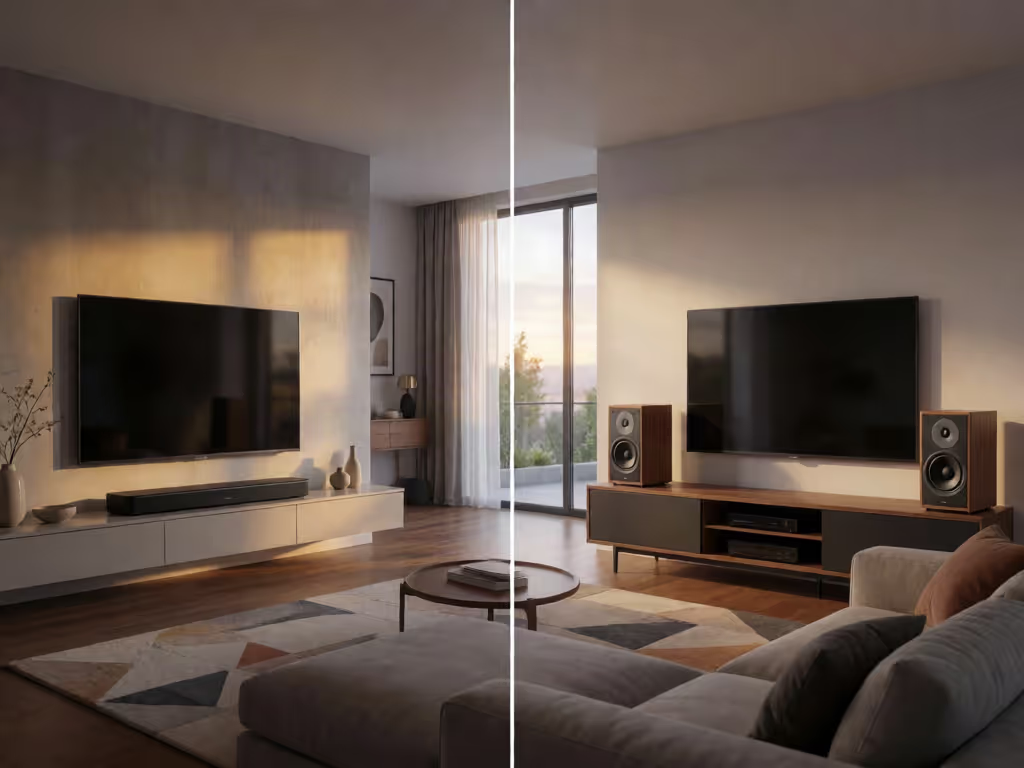
An all-in-one design puts the soundbar's channels and bass hardware in the bar itself. A soundbar-plus-subwoofer system splits those jobs between the main bar and a separate subwoofer. Neither layout is universally "better"; each asks you to accept a different compromise, as this integrated-versus-separate subwoofer comparison explains.
Using Samsung's S60D and Q800D as concrete examples makes the divide clear. Samsung documents the regional HW-S60D/XY as a 5-channel all-in-one soundbar with no included wireless subwoofer. Samsung documents regional HW-Q800D/KE and HW-Q800D/ZP versions as 5.1.2-channel systems with an included wireless subwoofer.
That designation matters only after the room does. It does not tell you how satisfying it will sound at your couch, how much bass you personally need, or whether either system will behave well through shared walls. Those outcomes need real-world listening in your room; they are not proven by the channel count.
The cleanest way to frame the decision:
- Choose all-in-one when a single compact enclosure is a hard requirement.
- Choose a wireless-subwoofer system when you can accommodate a second physical component and want the documented Q800D/KE or /ZP configuration with an included wireless subwoofer and 5.1.2 layout.
- Do not treat "wireless" as "space-free." The Q800D still has a separate subwoofer to place.
A separate subwoofer is not a free upgrade if it turns a clean room into an awkward room.
2. For tight furniture, compact wins before sound quality enters the debate
A compact soundbar solves a problem that review scores do not: fitting under the TV without crowding the stand, blocking its lower edge, or forcing a furniture rearrangement.
Samsung lists the HW-S60D/XY main bar at 670 × 62 × 105 mm (W × H × D), weighing 2.7 kg. That is a materially different footprint from the documented HW-Q800D/KE main bar, which measures 1110.7 × 60.4 × 120 mm. The Q800D's bar is roughly 44 cm wider on paper and 15 mm deeper; its height is close, but its width can be the deciding constraint on narrow media furniture.
The Q800D also adds the separate subwoofer enclosure. Samsung lists the HW-Q800D/KE subwoofer at 210 × 403 × 403 mm and 9.8 kg. Measure that volume before you decide that a wireless subwoofer is a simple add-on. It affects where you can put furniture and whether the setup still feels renter-friendly and uncluttered.
The practical measurement check
Before ordering either format, measure four things:
- Usable stand width: Measure the flat surface, not the TV panel's width.
- Vertical clearance: Check the gap between stand and screen, including any receiver or IR area you cannot cover.
- Soundbar depth: Confirm that the bar will not overhang into a walkway or past the stand's front edge.
- Subwoofer footprint: For a separate-sub system, mark out its stated width and depth on the floor with tape. If that square feels intrusive now, it will not improve after delivery.
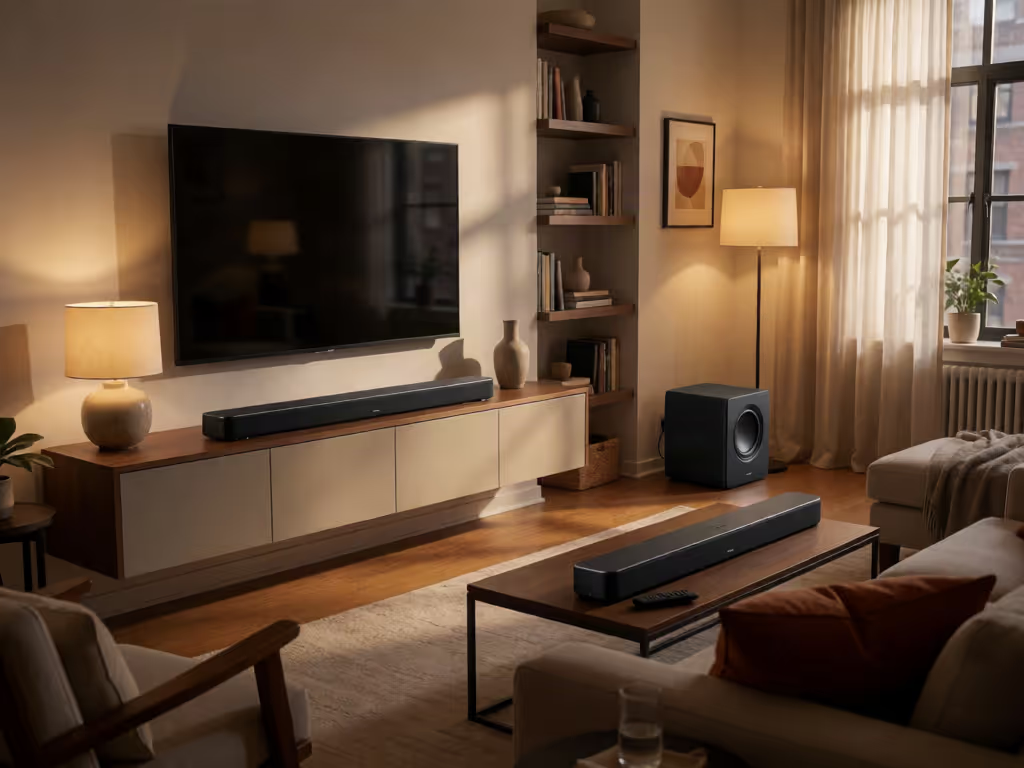
For small room audio, this is the first filter (not an afterthought); this soundbar placement guide can help you account for furniture, walls, and room layout. A system that physically belongs in the room gets used and tuned; one that crowds the room tends to become a source of compromise.
3. The bass depth comparison is less conclusive than buyers are told
This is where marketing makes the decision look easy: separate subwoofer equals more bass, all-in-one equals less. The configuration difference is real, but the available evidence does not provide a controlled, measured bass depth comparison between the S60D and Q800D. There is no verified head-to-head extension, output, or low-volume bass measurement to turn that assumption into a numeric verdict.
What can be said safely is narrower:
- The S60D/XY package does not include a separate wireless subwoofer.
- The exact retailer listing for the HW-S60D/ZA says it has built-in subwoofers; that is a retailer listing claim, not an independent bass measurement.
- The Q800D's documented regional versions include a separate wireless subwoofer as part of a 5.1.2 system.
- One publisher's listening impression described the Q800D's bass response as exceptional for its price class, but that is not a controlled comparison with the S60D.
So the honest answer on wireless subwoofer benefits is not "guaranteed deeper bass." The clearer benefit is architectural: the documented Q800D regional systems include a dedicated subwoofer component and carry a 5.1.2 designation. Whether that produces the bass balance you want depends on the room and your listening level.
For apartments and shared-wall homes, resist the temptation to turn a subwoofer into a promise of either theater impact or neighbor-safe listening. The available information does not establish either product as apartment-friendly or prove that Night Mode prevents sound transmission. The HW-S60D/XY and HW-Q800D/KE specifications list Night Mode, which gives you an available listening mode, not a guarantee about what others will hear.
4. Dialogue features are a tie on paper, not a measured winner
People shopping for their first serious TV upgrade often say "I need bass," then spend every evening riding the volume because dialogue gets buried; our guide to the best soundbars for TV dialogue clarity explores models designed to address that problem. Solve the voice problem first.
Samsung lists Voice Enhance Mode, Active Voice Amplifier, and Night Mode for the HW-S60D/XY and HW-Q800D/KE. Those are meaningful features to look for if you watch late, share the room with family, or need help following dialogue at modest volume. But their presence does not prove that one bar produces clearer speech than the other in your room.
The Q800D does have one limited outside listening observation in its favor: a publisher reported very clear dialogue and attributed it to a dedicated center channel. Treat that as a useful data point, not a lab result or a direct defeat of the S60D. No comparable independent dialogue test was available here for the S60D.
Buy on controls you can use nightly
For either type of system, check these in the actual version sold in your region:
- Can you quickly find and enable the dialogue-focused mode?
- Is Night Mode available and easy to toggle?
- Does your TV's placement leave the bar unobstructed?
- Can you return the product if speech still sounds recessed at your normal volume?
That last question matters. A few years ago, I lost a weekend blaming my aim during a stealth run when footsteps trailed the crouch animation and shots landed late. The fault was the chain (console to TV, then TV to bar), with processing everywhere. Once I simplified the route, used passthrough, enabled eARC, and locked game mode, the map felt immediate again. Do not buy audio hardware without considering the whole pipeline.
5. Gamers: do not confuse audio channels with HDMI capability
Neither a 5-channel label nor a 5.1.2 label establishes a console-friendly 4K/120 Hz path, VRR/ALLM support, or a specific audio-lag result. Those are separate HDMI-chain questions, and the available product evidence here does not verify them for these exact regional models; see our HDMI ARC versus optical comparison for the broader connectivity tradeoffs.
That is a critical limitation if your console feeds the soundbar first. Before you build a passthrough chain, confirm the exact regional manual and ports for the unit you will receive. If you route the console through the TV and return audio to the bar, confirm what your TV supports and test lip-sync with the games and apps you actually use.
A blunt gaming checklist
- Map the route: console → TV → soundbar, or console → soundbar → TV.
- Verify the exact model suffix: regional versions should not be assumed to have identical configurations.
- Test before the return window closes: check a fast game, a TV streaming app, and an external streaming device if you use one.
- Watch for lip-sync, not just dropouts: clean sound that arrives late is still a bad gaming setup.
- Avoid spec-sheet substitution: wireless Dolby Atmos, smart features, and channel count do not answer VRR/ALLM or 120 Hz passthrough questions.
A frictionless 120 Hz path with stable sync beats audio fireworks that introduce delay.
6. The Samsung S60D is the right comparison point when space is non-negotiable
If your priority is minimizing hardware, the Samsung HW-S60D is the clearer match in this pair. Samsung identifies the HW-S60D/XY as an all-in-one 5-channel model without an included wireless subwoofer, and its documented 670 mm width is far easier to accommodate than the documented HW-Q800D/KE bar's 1110.7 mm width.
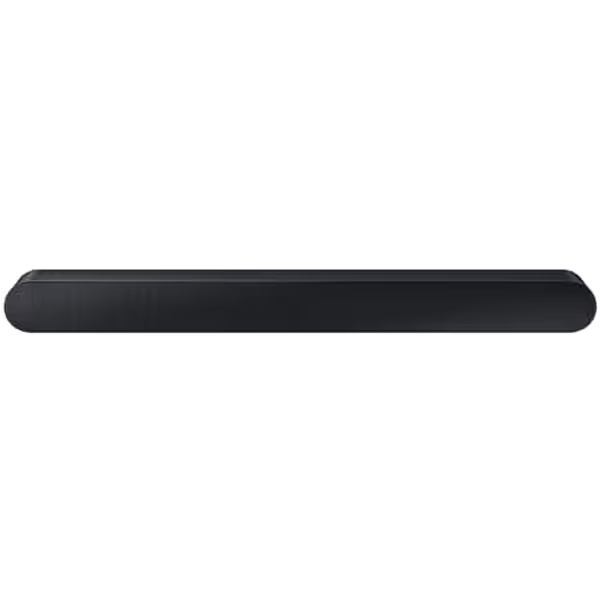
SAMSUNG S60D 5.0ch Soundbar
All-in-one soundbar delivers immersive Dolby Atmos audio without cable clutter.
Audio Channels5.0ch with Wireless Dolby Atmos
Audio Channels5.0ch with Wireless Dolby Atmos
Pros
Integrated subwoofers for rich bass without extra boxes
Wireless Dolby Atmos for clutter-free surround sound
SpaceFit Sound Pro and Adaptive Sound optimize audio for any room
Cons
Q-Symphony benefits optimized with Samsung TVs only
The exact HW-S60D/ZA retailer listing also describes built-in subwoofers. That makes it a sensible candidate for buyers who want to remove the separate-box decision entirely while retaining a soundbar-oriented TV upgrade. The HW-S60D/XY's documented voice-focused features and Night Mode are useful on-paper tools for speech-first viewing.
The tradeoff is simple: the available evidence does not establish how the HW-S60D/XY compares with the HW-Q800D/KE in bass depth. Buy it because the single-bar format is the fit you actually need.
7. The documented HW-Q800D/KE system earns its extra footprint only when you have room for it
The Samsung HW-Q800D/KE is the more expansive configuration on paper: Samsung documents 5.1.2 channels and an included wireless subwoofer. Its main bar is wider, and the subwoofer adds a substantial second enclosure. Those are not minor logistics; they are the price of choosing this format.
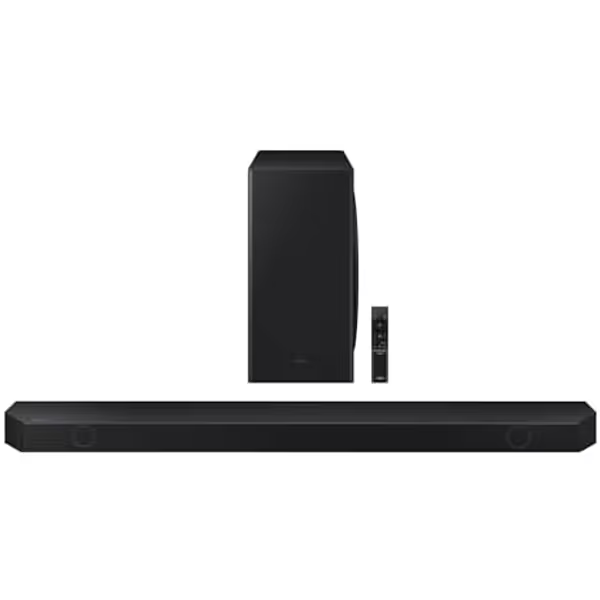
Samsung Q800D 5.1.2ch Soundbar
Immersive 5.1.2ch Dolby Atmos sound with smart room optimization.
Channels5.1.2
Channels5.1.2
Pros
Wireless Dolby Atmos for clutter-free 3D audio
SpaceFit Sound Pro automatically optimizes for your room
Crystal-clear dialogue with Adaptive Sound and AVA
Cons
Full Q-Symphony benefits require a Samsung TV
That extra hardware can be a good trade when you have a wider console, a stable place for the subwoofer, and a specific reason to want the listed 5.1.2 configuration. It is not automatically the right pick for every family room or apartment merely because the model has more channels.
Also keep the regional qualifier intact. The product listings supplied here are US-suffix models, while the primary specifications cited above cover other regional suffixes. Verify the exact model and retail package before treating the regional documentation as a one-to-one match.
8. My decision rule: choose the friction you can live with
Here is the short version.
Choose an all-in-one bar when:
- You need the smallest, cleanest physical setup.
- A second enclosure would make the room feel crowded.
- Your stand is narrow and the 670 mm documented S60D width fits cleanly.
- You want fewer placement decisions and the appeal of a single unit outweighs the desire for a separate subwoofer configuration.
Choose a wireless-subwoofer system when:
- You can genuinely accommodate the documented HW-Q800D/KE bar and separate subwoofer.
- You specifically want the Q800D's documented 5.1.2 structure rather than just a compact upgrade.
- You accept more physical setup in exchange for that system layout.
- You will verify the exact regional package and HDMI path before committing.
The best all in one soundbar is often the better purchase when it removes friction from the room and your daily routine. The documented HW-Q800D/KE system is the better purchase when its second enclosure and broader configuration solve a need you actually have, not when they merely look more impressive in a comparison chart.
9. Further exploration: make the final call with a 10-minute audit
Before you buy, write down your TV stand width, the available floor space for a subwoofer, your most-used source device, and whether gaming sync is non-negotiable; our soundbar buying guide offers a broader decision framework for matching those needs to the right setup. Then compare those answers with the exact model suffix and retailer package in front of you.
If the compact bar fits perfectly and keeps your chain simple, that is a legitimate win. If you have space for the documented HW-Q800D/KE or HW-Q800D/ZP system and want its listed 5.1.2 configuration with an included wireless subwoofer, explore that route, but verify the package and connections first. In soundbars, the best result usually comes from the system that fits the room, fits the pipeline, and preserves the latency budget, not the one with the flashiest number on the carton.
Related Articles
Comparisons & Face-Offs
PC Gaming Soundbar Comparison: Razer Leviathan V2 vs Stage SE
15th Aug•12 min read
Comparisons & Face-Offs
Accent Clarity Soundbar Comparison for Multilingual Dialogue
2nd Jun•13 min read