
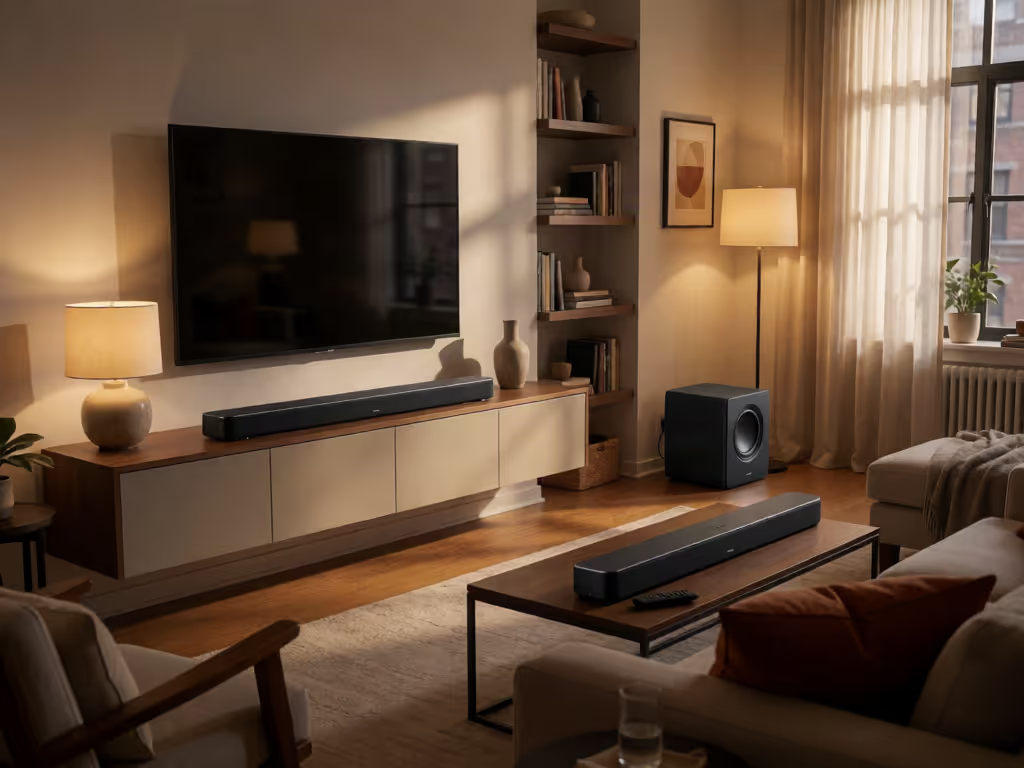
Compact Sound Bars With Subwoofer for Small Rooms and Apartments
By Tomas Novak • 15th Oct

Quick verdict
For a genuinely small console or narrow shelf, choose the Yamaha SR-C30A: its 23-5/8-inch bar is far easier to fit and it offers Clear Voice, Bluetooth, and multiple optical inputs. Choose the Polk Signa S4 when a 41.2-inch bar fits and you want a dedicated center channel, Dolby Atmos through eARC, and Night Mode for quieter viewing.
- Choose Yamaha if: Furniture width and a simple ARC or optical setup matter most. It also provides adjustable dialogue and subwoofer levels.
- Choose Polk if: Your TV supports eARC, you want Atmos capability and a center channel, and the wider bar fits beneath the display.
- Main trade-off: The available evidence does not establish an objective bass or overall sound-quality winner; independent testing is not like-for-like.
Important: Neither system is completely wireless: both the bar and subwoofer need AC power, and Polk’s Atmos setup requires eARC.
A wireless soundbar with subwoofer can be the cleanest upgrade from thin TV audio in a small room, but only when the physical fit, TV connection, and low-volume controls suit the room. Among these two sound bars with subwoofer, Yamaha's SR-C30A is the genuinely compact choice for a narrow console or projector shelf; Polk's Signa S4 is the wider choice for buyers who prioritize a center channel, eARC-based Dolby Atmos, and an explicit Night Mode.
The useful comparison is not "which is universally best?" It is: which signal path and footprint will stay easy to live with after the first weekend? Measure the furniture, inspect the TV's audio output, then choose the feature set you will use at normal apartment volume.
Route first, then features; reliability makes rooms feel cinematic.
FAQ: What is the practical difference between these two systems?
Yamaha SR-C30A: the compact-first solution
The Yamaha SR-C30A is a compact sound bar plus a wireless subwoofer. The bar is 23-5/8 inches wide, 2-1/2 inches high, and 3-3/4 inches deep. That narrow width is its clearest advantage. It is a sensible candidate when the TV stand has only a short open shelf, when a desktop display needs better sound, or when a projector setup needs a bar that does not dominate the front wall.
It connects to a TV through one HDMI ARC output, and it also has two optical inputs plus one analog audio input. Bluetooth 5.0 is available for music playback. Yamaha lists Dolby Digital and Dolby Pro Logic II support; its comparison information lists DTS Digital Surround as unsupported.
For everyday viewing, Yamaha includes Clear Voice for emphasizing speech, Bass Extension, four modes: Stereo, Standard, 3D Movie, and Game, and dedicated subwoofer-volume buttons. An independent listener found dialogue improvement effective, while also noting that Clear Voice could make some material more sibilant. The same review reported bass distortion and subwoofer rattle at extreme volume, so this is better treated as a controlled small-room system than one to run flat-out.
The wireless subwoofer configuration removes an audio cable between bar and subwoofer, but both units still need AC power.
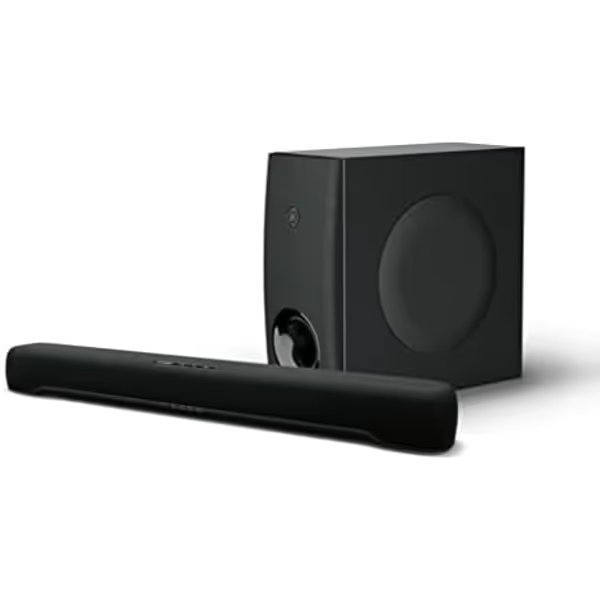
YAMAHA SR-C30A Compact Sound Bar
Compact soundbar with wireless subwoofer for immersive, clear audio.
Soundbar Width23 inches
Soundbar Width23 inches
Pros
Space-saving design with versatile subwoofer placement.
Clear dialogue and virtual 3D surround sound.
Dedicated sound modes for movies, games, and music.
Cons
Music sound quality may not satisfy all listeners.
Customers praise its strong bass for movies, though some wish music quality was better.
Customers praise its strong bass for movies, though some wish music quality was better.
Polk Signa S4: the dialogue-and-Atmos-forward option
The Polk Audio Signa S4 is a Dolby Atmos 3.1.2 sound bar with a wireless subwoofer. It is considerably wider at 41.2 inches, while its low 2.4-inch height can help it sit beneath a TV without blocking the lower edge or IR receiver. Its subwoofer measures 7.9 by 12.9 by 11.0 inches and uses a 5.9-inch woofer.
The architecture is different from Yamaha's: Polk includes a dedicated center channel. It also provides Voice Adjust in three levels, intended to make dialogue and vocals easier to hear. For households that routinely turn captions on because dialogue gets buried, that direct control is a meaningful distinction.
Its HDMI connection supports eARC or ARC. Polk states that Dolby Atmos requires an HDMI eARC connection between the television and the bar. There is also an optical input, 3.5 mm AUX input, Bluetooth, and USB playback; the USB connection is also identified for firmware updates.
Most important for apartment use, the Signa S4 has a Night Mode that compresses the gap between loud and quiet sounds, making low-volume listening easier. Bass level can be adjusted from the remote as well. Polk's manual says to place the subwoofer flat and near the bar, and the units are wirelessly connected by default.
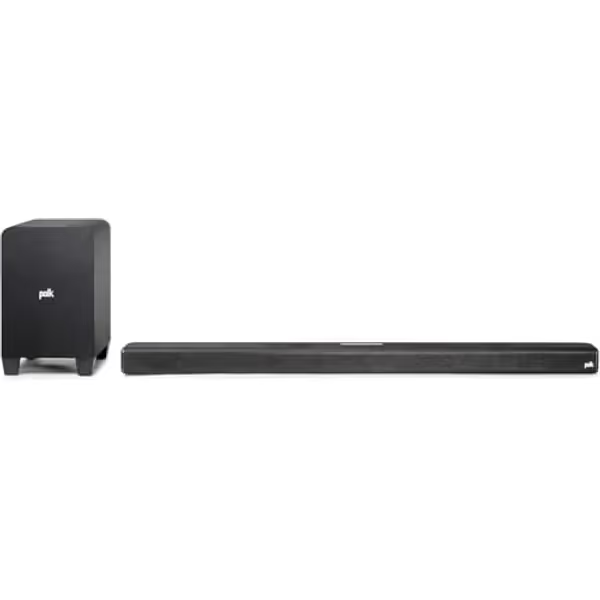
Polk Audio Signa S4 Sound Bar System
Immersive Dolby Atmos sound and clear dialogue in a slim, easy-to-set-up system.
Height2.36" (Ultra-Slim Design)
Height2.36" (Ultra-Slim Design)
Pros
Immersive 3D Dolby Atmos with up-firing speakers.
Clear dialogue with VoiceAdjust technology.
Slim design won't block TV or IR sensor.
Simple one-cable setup for any TV, including 8K.
Cons
Bass may be overwhelming in smaller spaces.
Customers praise the good sound quality for the price, clear vocals, and easy setup, with many highlighting the effective voice amplification.
Customers praise the good sound quality for the price, clear vocals, and easy setup, with many highlighting the effective voice amplification.
FAQ: Which one fits a small room better?
Choose by the furniture envelope first
Start with a tape measure, not an Atmos logo.
| Fit question | Yamaha SR-C30A | Polk Signa S4 |
|---|---|---|
| Sound bar width | 23-5/8 in | 41.2 in |
| Sound bar height | 2-1/2 in | 2.4 in |
| Sound bar depth | 3-3/4 in | 3.7 in |
| Primary small-room advantage | Very short bar | Very low profile |
| Subwoofer form | 13-1/4 x 6-1/4 x 14-3/8 in | 7.9 x 12.9 x 11.0 in |
The Yamaha is the better physical match when the available width fits its 23-5/8-inch bar but not Polk's 41.2-inch bar, or when the visual goal is a discreet bar. The Polk can work beautifully beneath a wider television, but it is not a compact-width product. Its low height is helpful only if the stand is wide enough.
Before ordering either, check four points:
- Bar clearance: Leave room for the sound bar's full width and depth, not merely the TV's footprint.
- TV sensor line: A low bar can still become a problem if it is placed directly in front of the receiver window. Test with a cardboard mock-up at the listed height.
- Two power outlets: "Wireless subwoofer" means no audio cable from the bar to the sub; it does not mean battery-powered. Plan one outlet for each component.
- Subwoofer path: Do not assume the sub can disappear behind every piece of furniture. The Yamaha manual specifically warns against metal furniture or metal objects between bar and subwoofer because they may interfere with the wireless connection.
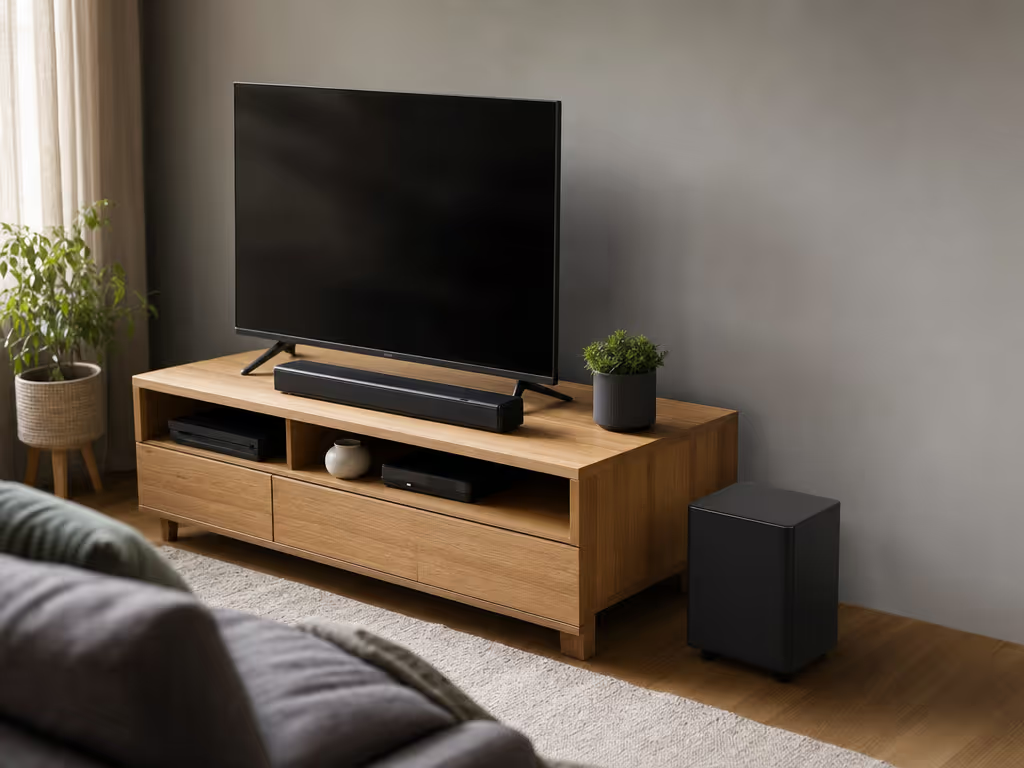
How should the subwoofer be positioned without turning bass into a neighbor problem?
With the evidence available for these systems, the serviceable approach is to follow their product-specific instructions and use their level controls rather than chase maximum output.
For the Yamaha, keep the speaker fabric from pressing tightly against a wall and do not block its bass-reflex port; Yamaha warns either condition can reduce bass volume. For the Polk, follow the manual's narrower placement instruction: a flat location near the sound bar. That is more useful guidance than assuming a wireless sub can be placed anywhere.
Then set the subwoofer level from the remote while listening at your real evening volume. The goal is a coherent foundation under dialogue, not a separate thump from a corner. For more guidance on getting the most from different room layouts, see this soundbar placement guide. If a scene becomes boomy, lower the sub level first. If voices become hard to follow, use Yamaha Clear Voice carefully or increase Polk Voice Adjust; with the Polk, enable Night Mode for late viewing. Those features matter most for quiet viewing, so compare models with a focus on late-night dialogue clarity before choosing a system for an apartment.
FAQ: Do I need HDMI eARC, or will ARC and optical work?
Build the simplest signal path your TV supports
Both systems can be connected by HDMI ARC. The Polk also supports eARC, and Polk says eARC is required for Dolby Atmos on the Signa S4. Yamaha's documented HDMI connection is ARC, not eARC.
A clean TV-centered route looks like this:
Streaming apps / console → TV → HDMI ARC or eARC → sound bar
 ↓
 wireless link → subwoofer
That route is usually preferable because it keeps the television as the video switcher and leaves only one audio cable visible. It also avoids creating an unnecessary chain of devices between the source and the TV.
Optical remains a documented option on both products: Yamaha has two optical inputs, while Polk has one; this HDMI ARC vs. optical comparison explains the broader reliability and feature tradeoffs. It can be practical when HDMI ARC does not behave as expected, but it is not the route Polk identifies for Atmos. Treat optical as a straightforward fallback for basic TV audio, not as a way to preserve every feature.
ARC hygiene matters here. Use the TV's labeled ARC/eARC port, select the matching audio output in the TV's menus, and test sound from the actual app or console you use. For a step-by-step walkthrough of ARC, optical, and Bluetooth connections, follow this soundbar setup guide. A successful menu tone is not the same as stable playback after the TV wakes from standby. If volume control or audio return is inconsistent, simplify the chain before blaming the bar: one direct cable, the correct TV port, and no unnecessary intermediate adapter.
What about a projector, streaming stick, or game console?
Neither product's available documentation establishes compatibility with every projector, HDMI switch, console mode, or television remote implementation. If your projector lacks ARC/eARC, do not buy on the assumption that either bar alone will create an audio-return path.
Map the source and sink before choosing hardware:
Streaming stick / console → display
 ↘ audio return or extraction path → sound bar
That missing middle path is where lip-sync and handshake stability are won or lost. I have seen a ceiling-mounted projector and distant media cabinet become dependable only after the route was mapped, a certified HDMI 2.1 switch with eARC extraction was added, and one long run was concealed in a paintable raceway. The lesson was not that every room needs extra hardware; it was that a tidy, defined signal path beats crossed fingers.
For gaming, these sound bars' supplied information does not establish 4K/120 Hz, VRR, ALLM, chat-audio behavior, or latency through an HDMI pass-through. Connect the console to the TV when possible, then return audio from the TV to the bar. Test the exact game and display mode before committing to cable concealment.
FAQ: Is Dolby Atmos meaningful in a compact apartment setup?
It can be meaningful only when the whole route supports it. The Signa S4 is a 3.1.2 Dolby Atmos design, but Polk specifies HDMI eARC as the required TV connection for Atmos. That makes it the feature-forward choice if your TV has eARC and you specifically want Atmos capability.
It does not make the Polk automatically the better choice for every smaller room. The Yamaha is much shorter, has an independent observation supporting its dialogue lift, and provides the inputs needed for a simple ARC or optical setup. There is no like-for-like independent measurement evidence here to crown either package the objective sound-quality or bass-depth winner.
A more accurate decision is:
- Choose Yamaha SR-C30A for very limited bar width, a simple TV/projector-adjacent installation, Bluetooth, two optical inputs, and adjustable dialogue and subwoofer level.
- Choose Polk Signa S4 for a wide enough TV stand, a dedicated center channel, adjustable dialogue, Night Mode, and an eARC TV where you intend to use Dolby Atmos.
FAQ: Are wireless subwoofers worth it, and are these systems completely wireless?
They are useful when the cable you want to eliminate is the one running from the sound bar to the subwoofer. Both systems use a wireless bar-to-sub link, which can make placement more flexible than a tethered subwoofer.
They are not completely wireless TV systems. Each package requires separate power for the sound bar and subwoofer, and both document wired TV audio connections through HDMI, optical, or analog audio. Plan the electrical outlets before choosing the subwoofer location.
The right compact system is the one you can keep handshake stable
For furniture that accommodates Yamaha's 23-5/8-inch bar but not Polk's 41.2-inch bar, Yamaha's SR-C30A is the clearer match. For dialogue-heavy viewing at low volume and an eARC-based Atmos path, the Signa S4 has the stronger documented control set, assuming its 41.2-inch width fits your room.
Further exploration should be practical: measure the console, identify the TV's labeled ARC or eARC port, and draw your actual source-to-display-to-audio route on paper. Once the cable route and outlet locations are settled, either of these sound bars with subwoofer can feel far more invisible day to day, and that is the upgrade worth protecting.
Related Articles
Comparisons & Face-Offs
PC Gaming Soundbar Comparison: Razer Leviathan V2 vs Stage SE
15th Aug•12 min read

Comparisons & Face-Offs
Accent Clarity Soundbar Comparison for Multilingual Dialogue
2nd Jun•13 min read