Best Soundbar Picks & Buying Guides
Best Apple HomeKit Soundbar Comparison for Seamless Apple Audio
29th Sep•13 min read
Neither Samsung model can be named the objectively best soundbar for podcasts or audiobooks: both listings advertise low-volume voice features, but there is no independent testing or direct comparison.
Important: One HW-S60D user reported clearer low-volume dialogue but still struggled at times, so neither model should be treated as a guaranteed solution.
Finding the best soundbar for podcasts or best soundbar for audiobooks is less about chasing maximum output and more about making narration easy to follow at the level you can comfortably use every night. For a TV-based listening setup, the two models reviewed here (the Samsung HW-S61D and Samsung HW-S60D) are relevant candidates because their listings advertise voice-focused processing, including clearer voices at low volume. But neither has the comparative independent testing needed to crown it the universal winner for spoken word.
That distinction matters. A soundbar can have a long feature list and still be the wrong fit if it blocks your TV, complicates your one-remote routine, or makes you turn the volume up just to catch a narrator's consonants. Let's run the real-room fit check before chasing bigger specs.
For podcasts and audiobooks, listen for a simple outcome: can you understand a narrator without repeatedly raising and lowering the volume? Our guide to soundbars for audiobook listening explores why consistent mid-range clarity matters during extended sessions. That is low-volume intelligibility, and it is a more useful target than surround labels or dramatic bass claims.
Use this quick checklist before comparing soundbars:
A compact all-in-one bar can be a sensible route when you want fewer boxes and less cable clutter. It is not a promise that every voice will suit every listener. Your room, the source recording, and your hearing preferences still decide the final result.
The right spoken-word setup is the one that lets you follow a chapter at your normal evening volume, not the one that only impresses during a loud demo.
Dolby Atmos, channel count, and smart features may matter for movies or gaming. For narration-first buying, begin with the features explicitly aimed at voices.
Both Samsung models are advertised with two such tools:
These features make both bars logical options to try if spoken-word clarity is your priority. Still, take the language for what it is: advertised functions, not a measured guarantee of better narration in every room or for every listener.
That caution is practical, not fussy. One HW-S60D owner reported that Adaptive Sound made dialogue clearer at low volumes, while also saying voice enhancement could still fall short at times. A single owner's experience is not a product verdict, but it is a helpful reminder to test with your own material during the return window.
The Samsung HW-S61D is the better fit to investigate first if you want an all-in-one, cable-light soundbar and use an Apple device for casual audio streaming. Its listing advertises a 5-channel configuration, built-in subwoofers, Adaptive Sound, AVA, and AirPlay 2 support. The listing notes that AirPlay 2 requires iOS 11.4 or later.

Consider the HW-S61D if your priority list looks like this:
For spoken-word buyers, the promising part is not simply the claimed five channels or built-in subwoofers. It is the combination of an all-in-one design with Adaptive Sound and AVA. In a small room, that can be a more relevant starting point than building a louder, more complicated system.
The available information does not establish how the HW-S61D performs against the HW-S60D for narration, whether it is less fatiguing over long audiobook sessions, or whether its voice processing will be stronger in a particular room. It also does not provide independent measurements of low-volume clarity.
So, do not buy it on the assumption that it is objectively the best soundbar for audiobooks. Buy it only if its feature set and tidy all-in-one approach match your setup, and plan a home test with material you know well.
The Samsung HW-S60D has the same core spoken-word focus in the available listings: Adaptive Sound is advertised to help voices at low volume, and AVA is advertised to optimize dialogue and commentary in the presence of room noise. A spec sheet also lists Night Mode, HDMI eARC, one optical digital input, and Bluetooth.
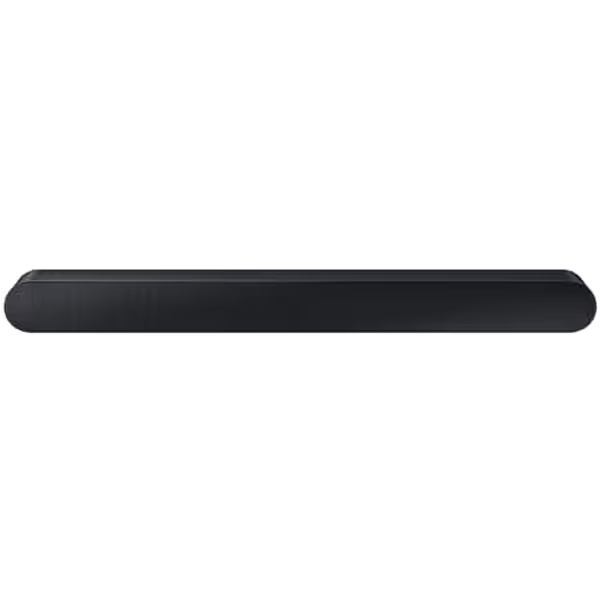
The HW-S60D is the more straightforward candidate when you can answer "yes" to one or more of these questions:
Night Mode is especially relevant to renters and parents, but keep expectations measured. The available spec does not explain exactly how it works or show that it specifically improves voice clarity. Use it as a mode to evaluate rather than treating it as proof that every quiet-volume problem is solved.
There is one anecdotal report on the HW-S60D worth handling honestly. The owner described clearer low-volume dialogue with Adaptive Sound, yet also said voice enhancement could use improvement and that dialogue was sometimes still hard to hear. That tells us neither that the feature fails nor that it will work for you. It tells us to make your own voice clarity test for narration the deciding step.
For my own thin-wall living, that testing habit has saved more frustration than any specification sheet. After one early week when bedtime overhead collided with movie night, I stopped treating 'sounds good' as enough. I mark the safe volume, use a familiar voices-first scene, and keep the setup that stays understandable without inviting a knock at the door.
Here is the evidence-based comparison.
| Decision point | Samsung HW-S61D | Samsung HW-S60D |
|---|---|---|
| Advertised low-volume voice help | Adaptive Sound | Adaptive Sound |
| Advertised dialogue-oriented processing | Active Voice Analyzer | Active Voice Analyzer |
| Advertised configuration | 5-channel; built-in subwoofers | 5-channel |
| AirPlay 2 | Advertised | Not established by the available information |
| HDMI eARC | Not established by the available information | Listed in retailer specifications |
| Optical digital input | Not established by the available information | One listed in retailer specifications |
| Bluetooth | Not established by the available information | Listed in retailer specifications |
| Night Mode | Not established by the available information | Listed in retailer specifications |
| Direct voice-performance comparison | No comparative evidence | No comparative evidence |
The useful conclusion is narrow:
Both models use substantially similar retailer feature language, but that does not prove they are acoustically identical or interchangeable. Compatibility and your in-room listening test should break the tie.
Once the bar is home, use this simple order. It prevents the common mistake of judging a soundbar before its basic connection and placement are settled.
Place the bar correctly where it will actually live. Confirm that it does not interfere with the TV screen, remote sensor, or the furniture edge. A compact bar is helpful only if it is physically comfortable in your layout.
For the HW-S60D, HDMI eARC and an optical digital input are listed connection options. Decide which route suits your TV before rearranging cables. If you are buying specifically for a projector or a gaming chain, pause and verify the full path for your exact devices; the available information here does not establish projector behavior, passthrough capabilities, or gaming latency.
On either model, begin by trying Adaptive Sound with your familiar spoken-word material. If you are watching a program with dialogue or commentary, AVA is another advertised voice-focused feature to evaluate.
With the HW-S60D, also test Night Mode for late listening. With the HW-S60D, also test Night Mode for late listening. For more guidance on quiet viewing, see these soundbars for late-night viewing, which focus on dialogue clarity and volume leveling at low volumes. Keep notes simple: Was the narrator easier to follow? Did you need less volume? Did the result remain natural enough for you?
You do not need to retune every evening. Make two repeatable routines:
The goal is to remove anxiety from the experience. Clear voices at a reliable, neighbor-safe volume are more valuable than a system you only enjoy when the house is empty.
Use one podcast episode and one audiobook segment you already know. Listen from your normal seat at your intended evening volume. Then ask:
If the answer is no, do not rationalize the purchase based on channel count or a feature list. The real-room fit check has done its job.
It can, but it is not guaranteed. It can, but it is not guaranteed. If hearing difficulty is a major factor, our guide to soundbar speech enhancement covers accessibility features and setup considerations in more detail. The HW-S61D and HW-S60D are both advertised with Adaptive Sound for clearer voices at low volume and AVA for dialogue-oriented optimization. One HW-S60D owner reported improved low-volume dialogue, but also occasional difficulty hearing voices. Test with your own content and room conditions.
Voice enhancement may not solve every difficult mix, recording, room-noise situation, or hearing preference. The available HW-S60D anecdote is a useful example: its owner found some benefit but not a complete fix. Treat enhancement as assistance, not a substitute for testing your normal listening routine.
The available information does not establish a universal requirement. For the HW-S60D, eARC is listed alongside an optical digital input. Choose based on the ports and behavior of your own TV, then confirm that your day-to-day source works as expected.
There is no evidence-based universal answer to the "best soundbar for podcasts" or "best soundbar for audiobooks" question between these two models. Both the Samsung HW-S61D and Samsung HW-S60D are feature-relevant options because their listings advertise Adaptive Sound for low-volume voices and Active Voice Analyzer for dialogue-oriented processing.
My final verdict: pick the HW-S61D if an all-in-one design and AirPlay 2 best fit your uncluttered listening routine. Pick the HW-S60D if its listed HDMI eARC, optical input, Bluetooth, or Night Mode gives you the cleaner path for your TV and quiet hours. Then judge the result with one familiar episode and one familiar chapter at your real evening volume. That is the decision that protects both voice clarity for narration and neighbor peace.
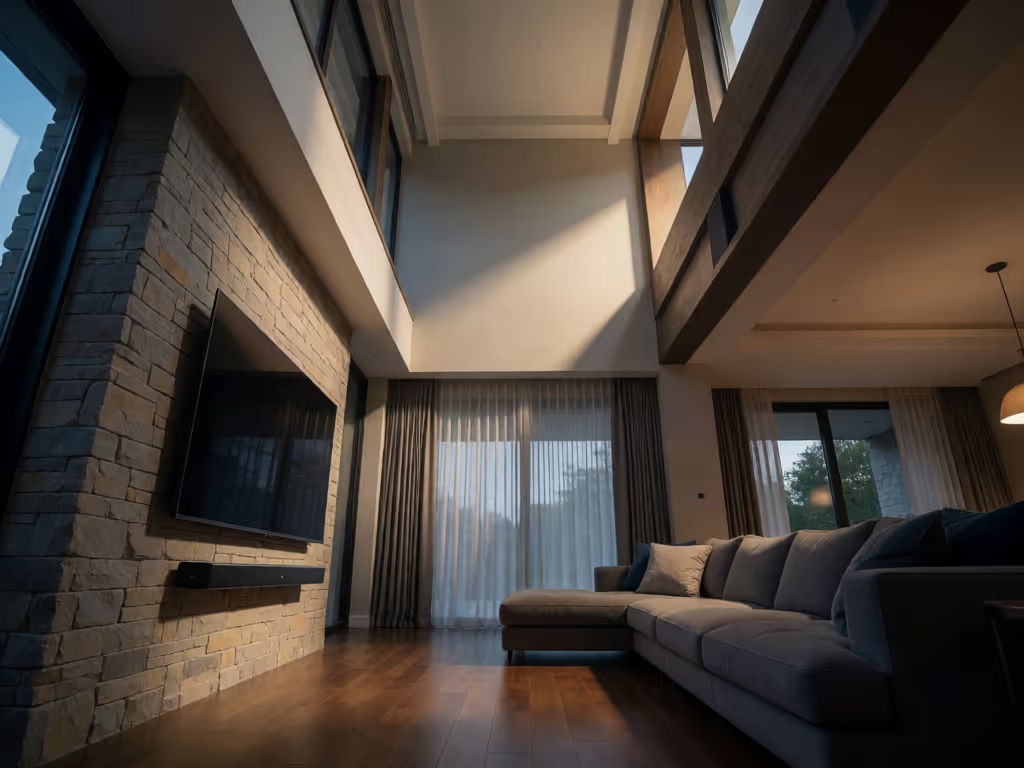
![Suggested Title: Dorm Room Soundbar Setup for Clear, Quiet TV Audio
This focuses on compact soundbars sized for dorm TVs that improve dialogue clarity while staying friendly to shared-wall quiet hours and student budgets[1][6][9].](/images/article/thumbnail/48cc1a59-35c7-41c5-a8c4-7c46b8f770e4.avif)