Best Soundbar Picks & Buying Guides
Best Gaming Speaker Bars With LED Lights for Clean RGB Rigs
28th Aug•13 min read
![Suggested Title: Dorm Room Soundbar Setup for Clear, Quiet TV Audio
This focuses on compact soundbars sized for dorm TVs that improve dialogue clarity while staying friendly to shared-wall quiet hours and student budgets[1][6][9].](/images/article/thumbnail/48cc1a59-35c7-41c5-a8c4-7c46b8f770e4.avif)
For a dorm TV, set up a compact soundbar around clear dialogue, verified connections, measured fit, and restrained volume—not maximum bass. Check your housing rules first, then map the TV-to-soundbar signal path and test speech at quiet-hours levels.
Important: Evidence does not establish a universal best soundbar, student-budget winner, or how bass or subwoofer use will affect dorm neighbors; model features, fit, and housing rules must be checked individually.
A dorm room soundbar can make dialogue easier to follow without turning a shared residence hall into a bass test track. The right compact soundbar for TV is not necessarily the loudest or the most feature-heavy. It is the one that physically fits, connects through a route your TV actually supports, and lets you hear voices at a restrained level. In student housing, that order matters: map the signal path, measure the furniture, then choose the features.
Route first, then features; reliability makes rooms feel cinematic.
Start with the problem you hear most often: dialogue disappears, so you raise the master volume, then music, effects, and commercials become too forceful. A useful dorm setup aims to reduce that volume riding. It should place the soundbar close to the screen, preserve clear speech at low-to-moderate listening levels, and avoid a cable arrangement that becomes fragile every time the TV stand is bumped.
This is also a housing question, not just an audio question. For example, Penn State Altoona's residence-hall policy says that courtesy expectations apply around the clock and that, during its quiet hours, electronic sound equipment must not be heard outside the room. Its listed quiet hours are institution-specific, not a universal campus schedule, but the practical standard travels well: check your own housing agreement and resident-life rules before treating evening TV as private.
A quiet-hours-friendly soundbar setup is therefore a setup behavior as much as a product category:
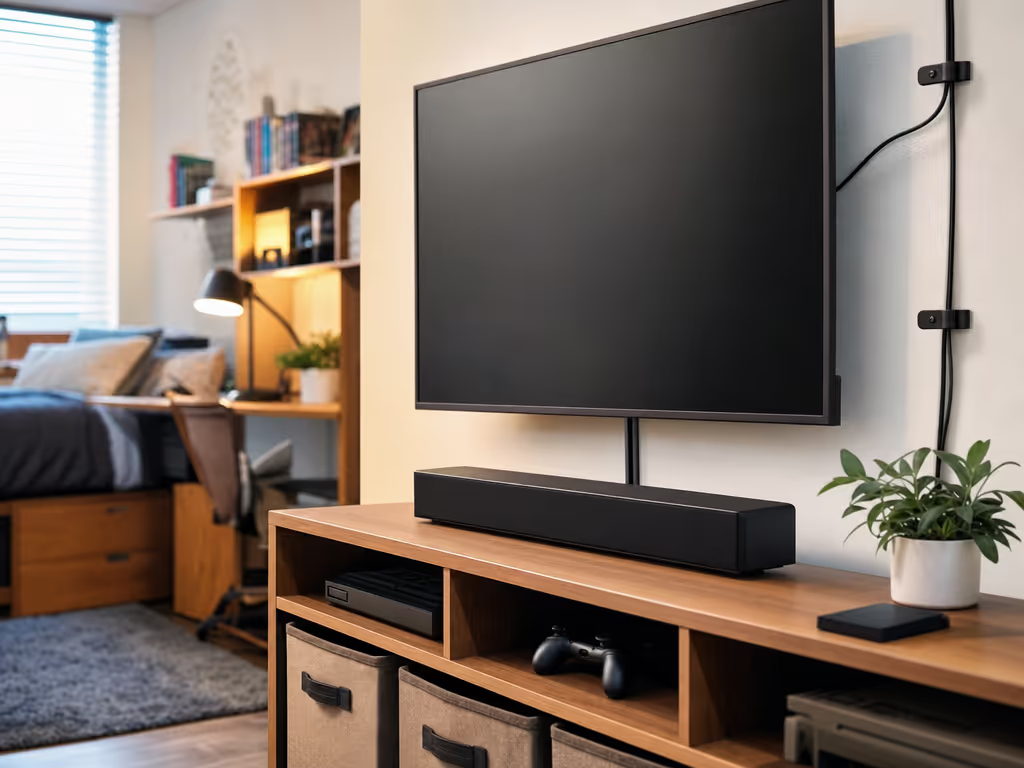
Measure before comparing feature lists. A bar that looks compact in a product photo can still cover the bottom edge of the picture, obstruct a remote-control sensor, or crowd the surface where cables need to bend.
Two published size examples show why numbers help. WIRED lists the Bose Smart Soundbar at 27.34 inches wide, 2.21 inches high, and 4.09 inches deep. It lists the TCL A65K at 34.65 inches wide, 2.05 inches high, and 1.97 inches deep. Treat these as starting points rather than a fit guarantee; compare every dimension with the documentation for the exact model and retail version you are considering.
Avoid improvising a permanent installation in student housing. A stable tabletop placement is usually the more serviceable route. For more guidance on getting the best performance from tabletop positioning, see this soundbar placement guide. Keep ventilation in mind as well: one Philips TAB8505 manual calls for at least four inches of surrounding space, but that is a model-specific instruction. Read the manual for your own bar rather than borrowing a clearance number from another product.
Do not buy based on the port label alone. First, look at the label next to the TV's HDMI sockets and then read the soundbar's connection instructions. The essential question is simple: Can these two exact devices return TV audio through the intended path? For step-by-step help with ARC, optical, and Bluetooth connections, use this soundbar setup guide.
For a model-specific example, Philips states that its TAB8505 can play TV audio through one HDMI cable when the TV is HDMI ARC-compliant and both HDMI-CEC and ARC are enabled on the TV. The same manual lists HDMI eARC/ARC, optical, 3.5 mm AUX, USB audio input, and Bluetooth pairing, but that menu of choices belongs to that model, not to every bar.
Before making or changing physical connections, disconnect the devices from power if your soundbar manual directs you to do so. That is the instruction in Philips' TAB8505 manual, and it is a good reminder that the manual (not guesswork) is part of the installation plan.
Clean routing is worth more than a clever workaround. Run one appropriate cable directly where possible, leave slack for moving the TV, and keep the run visible and accessible rather than trapping it under unstable furniture. I have dealt with the opposite extreme (a ceiling projector, a faraway cabinet, and an ARC handshake that would not settle), where mapping the route and simplifying the chain mattered far more than chasing another format badge. A dorm deserves the same discipline, only with fewer links.
Look for documented dialogue-oriented controls on the exact soundbar, then test them with familiar material. Do not assume that every compact model includes a speech mode, center-channel adjustment, or night setting.
Samsung, for instance, says its Voice Enhance mode improves dialogue in films and TV shows and identifies support on 2022-and-later Samsung soundbars in its Australian support guidance. On supported models, Samsung also describes center-channel adjustment from -6 dB to +6 dB, while noting that feature access can vary by model and software. That is a useful illustration of what to look for in a manual or support page, not proof that another brand or region offers the same controls.
Daytime preset
Quiet-hours preset
The target is not thin sound. For more strategies on maintaining clear dialogue at low volume, see these late-night viewing soundbar recommendations. It is a stable speech-to-effects balance that does not require frequent remote grabs.
It may be unnecessary, and it adds a placement and neighbor-consideration problem that a one-piece budget dorm sound system avoids. The available evidence does not establish how much bass or subwoofer use will disturb dorm neighbors.
If you already own a soundbar package with a subwoofer, follow that package's instructions precisely. Philips, for example, recommends positioning the TAB8505's included wireless subwoofer at least one metre from the bar and 10 centimetres from the wall. Those distances are specific to that package; they are not a general prescription for every subwoofer.
For a dorm purchase, decide whether clearer speech is your actual objective. If it is, a compact bar without a separate bass unit can be the cleaner starting point.
They can be a meaningful improvement when your benchmark is built-in TV or projector audio. WIRED found dialogue on the TCL A65K clearer than built-in TV or projector speakers. Its assessment also found that the bar's small form factor could not match pricier models' spatial sound. In the same guide, WIRED characterized the compact Bose Smart Soundbar as lacking overall power and bass.
That tradeoff can suit a dorm: better speech and a modest footprint may matter more than room-filling scale. It does not make every mini bar equally capable.
They are worth considering when TV dialogue is the daily frustration and you can confirm fit and connectivity before buying. They are less compelling when the bar blocks the screen, cannot use a documented connection with your TV, or encourages volume levels that conflict with resident-housing rules.
Before you choose a small soundbar for TV, write down four items: your usable TV-stand dimensions, the TV's labeled audio ports, the soundbar's documented connection options, and your residence hall's current noise policy. Then test your finished setup with the spoken-word content you actually watch during quiet hours.
That small plan prevents the common failure mode: a promising bar, a messy signal path, and dialogue that is still only clear when it is too loud. Cable discipline and a realistic listening target will do more for everyday student housing TV audio than a long list of features you cannot use.